How the "Best Tweet of the Day" Picker Works in X Bot
X Bot picks one "best tweet" per report from the period. Here is the rule, why we picked it, and what to do when the choice surprises you.
 by Nacho Coll
Nacho leads the Blockchain Web Services (BWS) team that builds and operates X Bot — the Telegram bot that turns X (Twitter) activity into leaderboards for crypto communities.
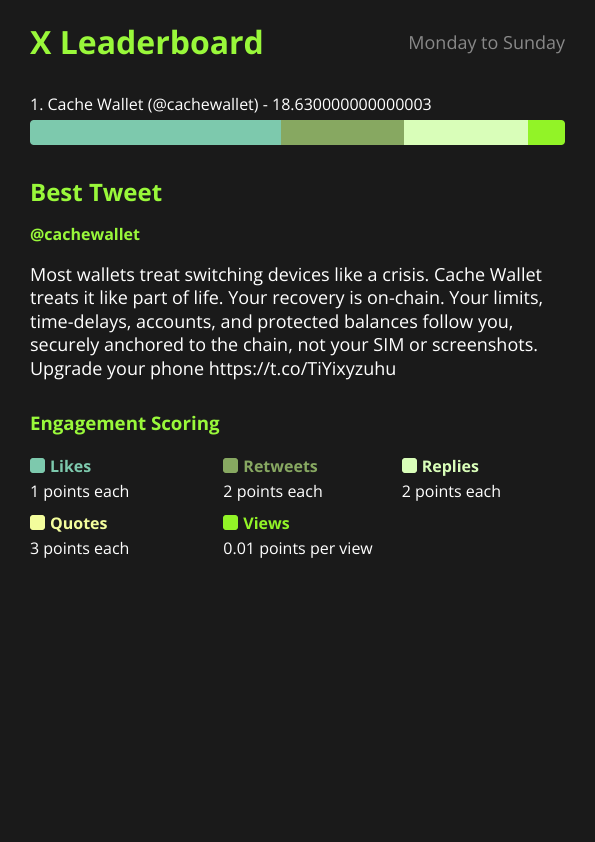
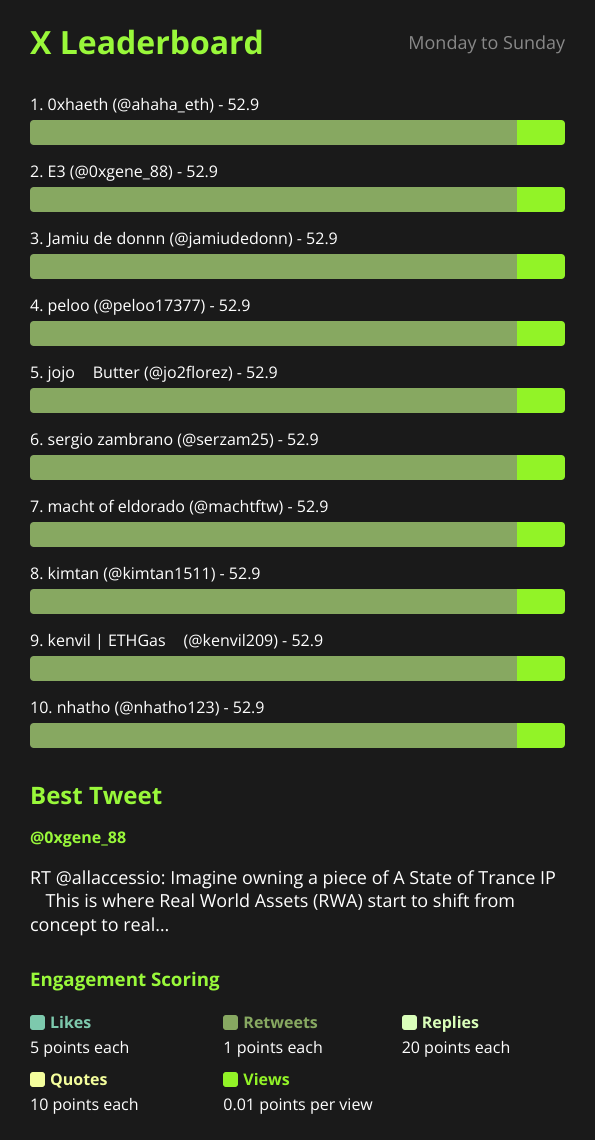
Every X Bot report ends with a single highlighted post: the “best tweet” of the period. It sits at the bottom of the leaderboard image, separate from the ranked scores, and it’s usually the thing people screenshot and forward to the rest of the team. But it’s also the part of the report that generates the most “wait, why did it pick that one?” messages in support.
This article explains the actual rule the best tweet picker uses, why it’s built that way instead of simply “highest score,” and what to do when it surfaces something that feels wrong for your community.
Why This Feature Exists at All#
The leaderboard itself already answers “who is performing best over this period.” That’s a ranking question, and it’s useful for accountability — you can see at a glance which KOL is carrying a campaign and which one hasn’t posted in a week. But a ranking doesn’t answer a different, equally important question: “what’s the single best thing that happened since the last report?”
Those are genuinely different questions. A KOL agency might have a client whose overall posting volume is modest but who dropped one exceptional thread that outperformed everything else tracked that week. The leaderboard ranking might place that KOL third or fourth by cumulative score, because cumulative score rewards consistency across multiple posts. The best tweet slot exists specifically to surface that one outstanding post even when it doesn’t change the overall ranking. It’s the difference between a batting average and a highlight reel — you want both, and they don’t always point at the same person.
For solo KOLs building a public portfolio, the best tweet slot often matters more than the ranking itself, since there’s no one else in the leaderboard to rank against. In a single-user tracked chat, the “leaderboard” reduces to one row, and the best tweet becomes the primary piece of new information in every report: which of this period’s posts actually landed with an audience.
What the Best Tweet Picker Actually Does#
Every tracked post that comes through your filters gets a composite engagement score — the same score that drives the leaderboard rankings, built from configurable weights across likes, retweets, replies, quotes, and views. The best tweet picker looks at every post scored during the current report period and selects the single highest-scoring one to feature.
That part is simple. The part people don’t expect is the second rule: the picker excludes posts that were already featured as “best tweet” in a recent prior report. It’s not pure highest-score-wins on an unbounded lookback — it’s highest-score-wins within a deduplication window that excludes recent repeats.
Why Deduplication Matters#
Without that second rule, a single viral tweet would dominate every report until it finally aged out of relevance. Imagine a KOL posts something that gets 40,000 likes on Monday. If the picker only asked “what’s the single best-performing post ever tracked,” that Monday tweet would win the “best tweet” slot on Tuesday’s report, Wednesday’s report, and every report after that until a bigger post came along — potentially for weeks.
That’s useless for a leaderboard that’s supposed to tell you what’s happening right now. Community managers and KOL agencies use the best tweet slot as a quick pulse check: “what’s the standout post since the last report?” If the answer is always the same three-week-old tweet, the feature stops doing its job.
The dedup window solves this by treating “best tweet” as a per-period distinction rather than a lifetime achievement. Once a post has been featured, it steps aside so the next report can surface a fresh standout, even if that fresh pick has a lower raw score than the old champion.
A Concrete Example#
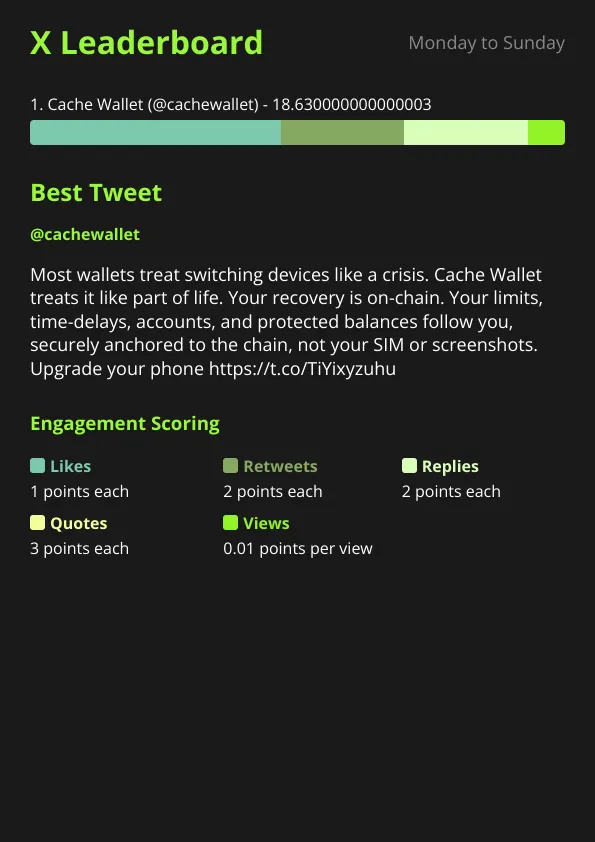
Say a token project runs a daily report at 09:00 UTC and tracks five hired KOLs through a named filter. On Monday, one KOL posts a thread that catches fire — thousands of retweets, easily the highest-scoring post the chat has ever tracked. Monday’s report correctly features it as the best tweet.
Tuesday, none of the five KOLs post anything close to that level of engagement — a normal day, a handful of routine posts with modest numbers. Without deduplication, Tuesday’s report would again feature Monday’s viral thread, because it’s still the highest-scoring post in the chat’s history. With deduplication, Tuesday’s report instead features the best of Tuesday’s own posts, even though by raw score it’s a fraction of Monday’s number.
This is the correct behavior for what the feature is trying to communicate. Tuesday’s report is supposed to answer “what happened on Tuesday,” not “remind me what happened on Monday.” If your team wants a running record of all-time top posts, that’s a different report shape entirely — the best tweet slot is intentionally scoped to recent activity, not a hall of fame.
The same logic applies to auto-relay-heavy chats that track a high volume of accounts. A multi-client KOL agency running several named filters in one chat will see each filter’s own best tweet pick, scoped to that filter’s tracked accounts and that filter’s report period — one client’s viral post won’t crowd out another client’s standout in a different named filter’s report.
How This Differs From a Simple “Top Post” Feed#
It’s worth being explicit about what the best tweet picker is not. It isn’t a running feed of every post above some engagement threshold, and it isn’t the same mechanism as 📡 X Posts Auto-relay, which forwards posts from selected accounts into the chat as they’re published, independent of scoring or report timing. Auto-relay is about speed — getting a post in front of your team within minutes of publication. The best tweet picker is about curation — looking back over a full report period and picking the one post worth calling out.
Chats that use both features get a useful combination: auto-relay surfaces posts in near-real time as they happen, and the next scheduled report’s best tweet slot retroactively confirms which of those relayed posts turned out to be the standout once engagement had time to accumulate. A post that looked promising when it was relayed might not end up scoring highest once likes and retweets settle over the following hours — the best tweet picker is the more considered, delayed judgment, not the fast one.
When the Choice Feels Off#
A few situations reliably generate “why did it pick this one?” questions:
Low-engagement windows. If your tracked accounts had a quiet day — nobody posted anything that landed — the picker still has to choose something from what came through. The result can be a post with modest engagement that looks unremarkable compared to your usual standouts. This isn’t a bug; it’s an honest reflection of the period. A quiet best-tweet slot is useful signal that engagement dipped, not a picker malfunction.
Niche topics floating up. Sometimes a post with a smaller total engagement count wins because it scored well on the specific weights your chat has configured. If you’ve weighted replies heavily because you care about conversation over passive likes, a post that sparked a genuine back-and-forth can outscore a post with more raw likes but a shallower discussion. This is the scoring system working as configured — check your weights under 🎨 Customization if the picks consistently favor an engagement type you don’t actually care about.
Recency bias from the dedup window. Because recently-featured posts are excluded, a “best tweet” pick can occasionally be a post that would have lost head-to-head against something already featured a report or two ago. This is intentional — see above — but it’s worth knowing so you don’t assume the picker is directly comparing every post against every other post it’s ever seen.
Tuning the Best Tweet Behavior#
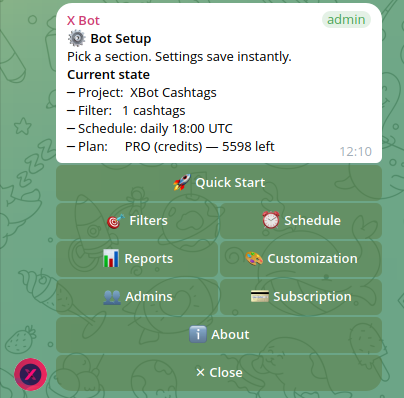
The scoring weights that feed into the best tweet picker are the same ones that drive your leaderboard rankings, configured under 🎨 Customization in /setup. If your best tweet picks consistently feel misaligned with what your community actually cares about, adjusting those weights (leaning more on retweets for reach, or replies for conversation quality) will shift both the leaderboard order and the best tweet selection together — they’re not tuned separately.
If you need something more specific — a different dedup window length, or a way to exclude certain content types from best-tweet consideration entirely — that’s a per-chat configuration that isn’t exposed in the standard menu yet. Reach out through ❓ Help & Support in /setup and describe what you’re seeing; the underlying selection logic is configurable per chat on request.
Best Tweet in Context#
The best tweet picker is deliberately a small feature — one line in a much larger report. It works alongside the rest of the report image: per-user scores, activity counts, and (if you’ve set it up) auto-relay forwarding the post itself into the chat in near-real time.
Think of it as a spotlight rather than a ranking. The leaderboard already tells you who’s winning on volume and consistency. The best tweet slot tells you what actually landed — which is a different, and sometimes more interesting, question. For a KOL agency, that’s often the post you use in a client update. For a token-launch coordinator, it’s frequently the messaging angle worth repeating in the next campaign push.
If the pick surprises you, that’s usually the scoring weights or the dedup window doing exactly what they’re supposed to do — not a mistake to fix, but a signal worth reading. For full details on scoring and plan limits, see the pricing docs and the setup menu reference.
Not sure whether you need real-time monitoring or scheduled reporting? Our X Bot vs X Pro vs TweetDeck comparison breaks down when each approach wins.
Ready to track your community on X? Add @BWS_X_Bot to your Telegram group, run /setup, and your first report fires on the configured schedule. The FREE plan covers 100 posts/month — no card required.
About this article: This post was drafted with AI assistance using X Bot’s content workflow and reviewed by Nacho Coll, Founder & Principal at Blockchain Web Services (BWS), before publishing. Every product claim is checked against the live bot. Read how we use AI in our content. Spot an error? Reach us via
/setup→ ❓ Help & Support.
About the author
Nacho Coll
Founder & Principal, Blockchain Web Services
Nacho leads the Blockchain Web Services (BWS) team that builds and operates X Bot — the Telegram bot that turns X (Twitter) activity into leaderboards for crypto communities. He writes about KOL performance tracking, the X API, and running analytics bots for Telegram groups, from the operator side of the wire. Building on blockchain and decentralized infrastructure since 2019.
- best tweet picker
- tweet ranking algorithm
- telegram bot best tweet
- ai tweet selection